A Shared Skill-Swap Afternoon with No Shopping List
Plan a shared skill-swap afternoon that keeps attention on teaching and participation, with simple ways to handle uneven confidence, time, and group energy.
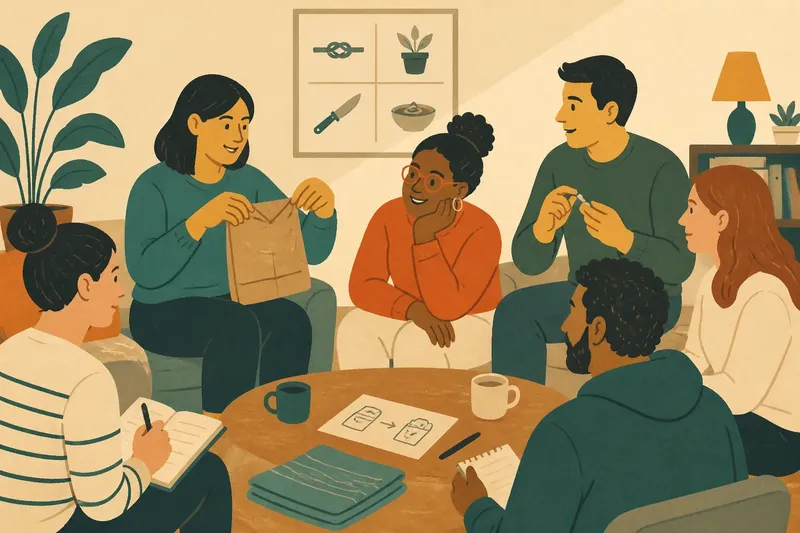
You invite a few friends over for a shared skill-swap afternoon, and the first reply is, “What should I bring?” That question can quietly turn a relaxed gathering into a supply hunt. The simplest answer is that nobody needs to shop: each person brings one skill they can demonstrate using what is already on hand, or by teaching without materials.
The point is not to leave with a polished project. It is to let people trade small, useful bits of know-how—how to fold a fitted sheet, mend a loose button, sharpen a kitchen knife safely, or remember names at a party. When something feels awkward, the cause is often a mismatch between the plan and the group’s comfort, not a lack of talent. Here is how to spot common snags and adjust the afternoon in order.
Why does the invitation sound like a supply assignment?
People often hear “skill swap” and picture a craft workshop with materials, a finished object, and a host who has to prepare a kit. That expectation can make guests delay answering or feel they need to bring something impressive. A shopping list also shifts attention from what people know to what they own.
Make the invitation explicit: “Bring one thing you can show or explain; no purchases or special supplies.” Mention that a skill can be practical, social, creative, or simply a trick that makes an ordinary task easier. A guest who can teach a quick way to pack a lunch container is just as welcome as someone who knows a knitting stitch.
If a demonstration uses an item someone already owns, let the person bring it only if convenient. Offer a no-object option: explain the skill, sketch it on scrap paper, or invite everyone to practice the idea with their hands. The gathering should work even if nobody arrives with a bag.
Keep the invitation short enough that people can say yes without planning a project.
What if someone says they have nothing to teach?
This usually comes from treating “skill” as a credential: a craft mastered over years, a professional specialty, or something unusual enough to impress a room. That standard excludes the everyday knowledge a swap is meant to make visible. Many people can show a small task they have learned by repetition, even if they have never called it a skill.
Give a few gentle prompts rather than asking people to brainstorm from scratch. Could they show a way they organize a crowded drawer, make a simple sauce, keep houseplants from drying out, untangle a necklace, or calm a nervous dog during a routine? Invite them to share a method they are still learning, too, as long as they are comfortable describing what has helped so far.
Say you invite Maya, who claims she has nothing to offer. She remembers that she can fold a paper grocery bag into a compact drawer liner. She demonstrates it with a bag already at home, and the group can see the fold and ask questions; nobody needs to treat her as an expert or turn the afternoon into a craft lesson.
Let “I can show you one small thing” count as enough.
How can everyone get a turn without making the afternoon feel scheduled?
A loose gathering can drift toward the most talkative guest. A tightly timed program can create the opposite problem: people start watching the clock instead of listening. Both usually happen when the host assumes the group will somehow divide attention evenly without agreeing on a shape.
Offer a light structure at the start. Each person can name their skill in a sentence, then the group can choose an order by interest or simply go around the room. Keep the first demonstrations brief enough to leave room for questions and conversation; if a topic catches on, allow it to continue while making sure quieter guests still have an opening.
For a small group, it can help to pair people for a few minutes after everyone introduces their skill. A guest who wants to learn a knot can ask its teacher directly, while another pair talks through a simple recipe. Avoid forcing anyone to perform in front of the room. Watching, asking a question, or passing is participation too.
Use a visible kitchen timer only if the group wants help sharing the floor, and treat it as a gentle cue rather than a buzzer.
What should you do when a demonstration needs more supplies?
A skill may turn out to depend on a special tool, a particular ingredient, or more practice space than the host has. The usual cause is that the idea was chosen as a finished activity rather than a small demonstration. No one needs to improvise a substitute that feels unsafe or frustrating just to keep the plan intact.
Before the gathering, ask guests to describe their idea in one line and mention any object they might use. This is not a request to buy anything; it lets the host notice obvious limits, such as a lesson that requires a large work surface in a crowded living room. If an item is not already available, the guest can explain the principle, show a photograph they already have, or choose another skill.
Keep ordinary shared items like scrap paper, pens, and a few chairs nearby if they are already in the home. They are convenient, not mandatory. A guest can teach a memory technique by describing it aloud, or demonstrate a simple stretch without turning the gathering into a fitness class.
For anything involving tools, food handling, or other safety considerations, follow the relevant product directions and local guidance; do not turn a casual swap into unsupervised instruction.
What if one person’s skill takes over the whole gathering?
Some demonstrations naturally invite a long story or a stream of questions. Others are so familiar to the teacher that they do not notice how much background the group is missing. The cause is often a difference in pace, not a lack of generosity.
Help the teacher find a small stopping point before they begin. A useful frame is: what is the task, what is one thing to notice, and what can a learner try? For instance, a guest showing how they keep a weekly meal plan may demonstrate one decision—choosing a meal that uses an ingredient already in the fridge—instead of walking through every household routine.
As host, you can step in kindly: “Let’s pause there so someone else can ask a question,” or “Could we hear one more skill before we come back to this?” If the group is absorbed, ask whether they want to stay with the topic or move on. A small signal works better than silently hoping the session will rebalance itself.
Give the person a clear chance to finish, then open the floor to the next voice.
Why might people watch but not try?
A demonstration can feel like a performance, especially if the teacher is confident and the learners are not. Guests may worry that they will make a mistake, ask a basic question, or look clumsy. A room full of observers is not necessarily disengaged; people may need a lower-pressure invitation.
Ask the teacher to offer a choice: watch, ask, or try. Let learners practice in pairs or on their own rather than making one person demonstrate in front of everyone. For a skill that can be talked through, such as remembering a name or planning a simple grocery route, participants can think of their own example without sharing it aloud.
Do not praise only the most polished attempts. Notice useful questions and thoughtful adaptations, too. A learner who says, “That would work better for my tiny kitchen if I did this part first,” is contributing to the exchange, even if they do not copy the demonstration exactly.
Make passing an ordinary option, not a sign that someone has failed to join in.
How do you handle these common skill-swap questions?
How many people should come to a skill-swap afternoon?
Choose a group small enough that each person can speak without competing for attention. If invitations bring more people than expected, split into pairs or small circles rather than asking everyone to present to one large audience.
Does every guest need to teach something?
No. Guests can share, ask questions, watch, or help someone practice. An invitation can ask everyone to bring an idea while making clear that nobody has to present if they would rather join in another way.
What if two people bring the same skill?
Let them compare approaches or combine their turns, if they both want to. Similar knowledge can make a useful conversation, but neither person needs to compete for the “best” method.
Should the host prepare refreshments or an activity?
Keep hospitality separate from the exchange: water, tea, or a simple snack is enough if it suits the gathering and the host’s capacity. The host does not need to supply a project, lesson materials, or a backup performance.
How can you close the afternoon without turning it into homework?
A gathering can end awkwardly when the host feels obliged to produce a takeaway, group photo, or promise of a future event. That pressure comes from assuming the exchange needs a formal result. A good ending can be as simple as making room for people to say what they enjoyed or what they might try later.
Near the end, invite each person to name one idea they are taking with them, or let them pass. Do not ask for commitments to practice, teach again, or organize the next meeting. If guests want to trade a recipe or send a reminder, they can arrange that themselves.
For a shared skill-swap afternoon, the most useful measure is whether people had a chance to offer and receive attention—not whether they carried home an object. A loose plan, a clear no-shopping invitation, and permission to participate quietly can make that exchange feel generous without asking the host to stage a workshop. Keep a note of the prompts that helped your particular group, and use only the ones that made the next gathering easier to join.