The Second Life of a Familiar Object: Start with Its New Job
Give reuse a clearer starting point: name a specific new job for an object, then decide whether its shape, condition, and setting suit that use.
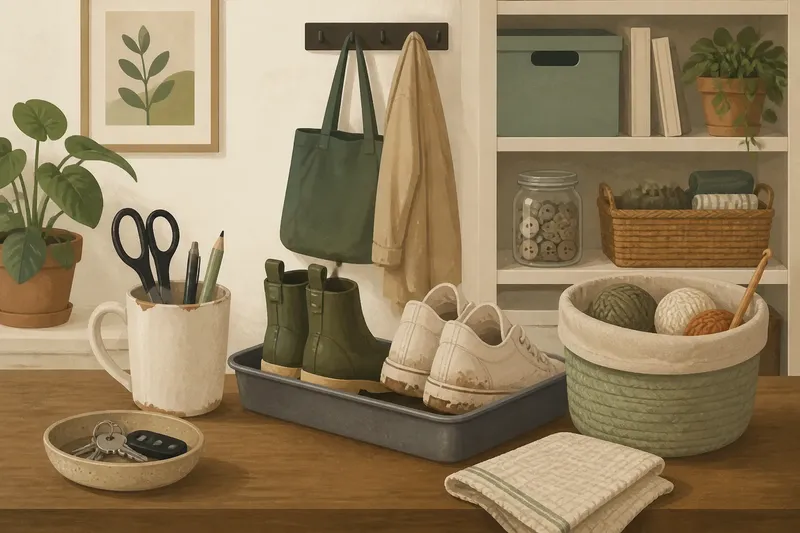
A chipped mug sits beside the sink, too worn for coffee but just right for holding pens. That small change of purpose captures the useful trick behind reuse: instead of asking whether to keep or discard an object, name a job it could do next. A specific task makes possibilities easier to see—and makes it easier to tell a promising idea from a pile of clutter.
Why start with a job, not a label?
“Keep,” “donate,” and “toss” are sorting labels. They can help with decisions, but they do not reveal what an object is suited to do. A “maybe” box, for instance, can preserve items without giving them a reason to stay.
A new job changes the question. Could this jar hold buttons? Could an old towel become a cleaning rag? The answer depends on visible qualities: size, material, stability, cleanliness, and how the object feels to use. You are not trying to invent a clever use for everything. You are looking for a task the object can genuinely handle.
Keep the proposed job concrete. “Storage” is broad; “hold the spare keys by the entry” gives you a place, contents, and purpose to check.
Which approach fits your object?
Three approaches cover most household reuse ideas. Pick the one that matches what you already know: the task you need help with, the object’s distinctive feature, or the place where it might be useful.
Start with a task you already do
Think about a small recurring need: keeping recipe cards together, catching drips under a houseplant, or carrying library books from the car. Then look for an object that can meet that need without awkward adjustments. This approach suits anyone who wants practical reuse, especially when a particular drawer or surface is already getting messy.
For example, say you keep misplacing the scissors used for opening mail. Imagine an empty, clean food tin with a stable base and no sharp edge. Giving it the job of holding those scissors in the desk drawer has an observable result: the scissors have a regular home, and the tin is no longer sitting unused. If the tin tips or catches your hand, choose another container or leave it out of service.
Start with an object’s strongest feature
Look for a quality that invites a particular use: a shallow tray, a sturdy handle, a soft fabric, or a small opening. A shallow baking pan might corral muddy shoes near the door; a fabric tote may gather yarn beside a chair. This approach suits people with a sound object on hand but no immediate task in mind.
Let the feature narrow the search instead of stretching the object beyond its abilities. A basket with a loose handle may still hold scarves on a shelf, but it is a poor choice for carrying heavy groceries.
Start with a place that needs something
Scan one lived-in spot, such as the bedside table, entryway, or craft shelf. Ask what is missing there: a place for charging cables, a cover for a dusty item, or a container for loose game pieces. This option suits people who prefer to reuse something where it will be seen and used, rather than moving another object into a storage box.
A good match has a clear destination from the outset. If you cannot point to where the object will go, the new job may be more appealing in theory than in your routine.
How do you check whether the new job fits?
- Name the task. State what the object will hold, protect, carry, or organize. If you need a long explanation, the job may be too vague.
- Check the fit. Compare the object’s shape and capacity with the intended contents. A container should not force items into a cramped or unstable arrangement.
- Look at its condition. Notice cracks, loose parts, stains, odors, rough edges, or fabric that sheds. An object that cannot serve comfortably may not be a useful candidate.
- Choose its home. Identify the room, shelf, drawer, or work surface where it belongs. A new job is easier to maintain when the object is near the task.
- Notice the trade-off. The object may stop serving its old purpose, and another person may have a better use for it. Decide whether this new role is worth giving up that option.
- Set a review point. After using the object in its new role for a while, ask whether it still helps. If it keeps getting moved aside, revise the job or release it.
For items that touch food, sit near heat, or support a person’s weight, use ordinary caution and follow product labels, manufacturer instructions, and local rules. Reuse is not a reason to overlook what an item is made to handle.
What do people often ask about reuse?
What is the difference between reuse and repurposing?
Reuse often means putting an item back to work in its original role, such as using a storage box to store different supplies. Repurposing gives it a different role, such as turning that box into a holder for board-game pieces.
How do I keep a new use from becoming clutter?
Assign the object a place and a task before bringing it into a room. If it has neither, hold off on storing it until a genuine need appears.
What if I can imagine several possible jobs?
Choose the job with the clearest destination and the least adjustment. If two uses seem equally useful, try the one that leaves the object easiest to redirect later.
Should I keep something because it might be useful someday?
A possible future use is easier to judge when you can name the task and the place it would serve. If you cannot do either, it may be more helpful to pass the item along than to save it without a plan.
How do you choose between the approaches?
Start with the task if you already notice a small inconvenience. Start with the object’s feature if one particular quality stands out. Start with a place if a familiar corner of your home needs a specific kind of help.
Then make the decision reversible where you can. A jar can hold buttons without being altered; a wooden box might need cleaning before it becomes a desk organizer. Prefer the use that asks for little change and has a visible place in your routine. If none of the options fits, the object does not need a second job just because one is imaginable.
The second life of a familiar object begins with a task you can actually point to. When you look at what you own, try asking, “What would I use this for next week?” That question keeps reuse tied to real needs—and leaves room to let go when no suitable job appears.